Dorrigo Evans’s selection of POWs for the Three Pagoda Pass march
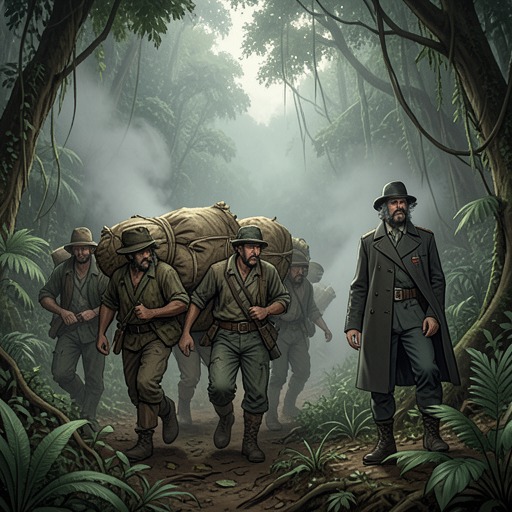
The Narrow Road to the Deep NorthDorrigo Evans’s selection of prisoners for the Three Pagoda Pass march is a coerced act of triage in which every available choice serves the machinery of death. Ordered to name one hundred men from a camp of seven hundred, Dorrigo tries to give the selected prisoners the best chance of surviving a hundred-mile march into the jungle. He knows that most will probably die anyway, and that choosing them makes him both their protector and the agent who condemns them to leave.
The Order and Its Stakes
Dorrigo has momentarily nodded off from exhaustion while the parade assembles. Near midnight, he turns to the men and explains that he must select one hundred to march to another camp near Three Pagoda Pass, one hundred miles deeper into the jungle of Siam. They are to leave immediately after the morning parade. The order had come an hour earlier from Major Nakamura, accompanied by Lieutenant Fukuhara. Dorrigo argues that no prisoner in the camp is capable of the journey; Major Nakamura insists that the hundred must be found.
The selection is made amid disorder that compounds the cruelty of the task. The men are counted and recounted, but the numbers do not tally. More prisoners stagger in from the Line; men on light duties, cooks, and hospital patients are brought to the parade. Sergeants try to establish who is present and who is missing, while Fukuhara argues with the guards. An Australian sergeant is slapped around, and the count has to begin again. The administrative confusion does not soften the order: each man must ultimately be accounted for, and one hundred must be sent away.
When Dorrigo says that the men will all die, Fukuhara translates his warning to Major Nakamura. Nakamura answers that their deaths would be a very good thing because they would save the Japanese army rice. The exchange strips the order of any pretence of care: the prisoners’ likely deaths are treated as an economy. Dorrigo understands that if Major Nakamura chooses, he may select indiscriminately, including the sickest men, who are least useful to the captors. If Dorrigo chooses, he can at least send those he believes have a better chance of living. That distinction offers a narrow possibility of protection, not a way out of the death march.
The Work of Choosing
The camp’s condition makes Dorrigo’s judgment bodily and immediate. He has spent his time holding, nursing, cajoling, begging, hoodwinking, and organising the seven hundred men into surviving, always putting their needs before his own. Now they stand before him in rags, skeletal under the lantern light. Some shake with malaria; some soil themselves where they stand. Men collapse from exhaustion and are left lying in the mud. Dorrigo must look at the people he has tried to keep alive and decide which of them can endure another hundred miles.
He lowers his lantern to inspect their feet, because boots are among the few things that might help a prisoner survive. The bare feet are infected or swollen with beri-beri; others are eaten by ulcers. At one man’s leg, a severe untreated ulcer has consumed nearly all the skin, exposing damaged tissue and bone. The prisoner is Chum Fahey, reduced to a pale, wasted figure. Dorrigo decides that Chum cannot go. The act of selection is thus neither an abstract calculation nor a simple division of the fit from the unfit: it involves seeing each damaged body, naming a man, and deciding whether he can bear the journey.
Dorrigo moves up and down the rows, touching and naming the men he judges most likely to cope. The selection gives him no confidence that his judgment can save them. He chooses those with the best chance of not dying, while knowing that most are likely to die nevertheless. His task is not to rescue a hundred men from the order but to make the imposed choice less indiscriminate, one prisoner at a time.
A Column Passes
As the counting and selection continue, a long column of Japanese soldiers marches along the rough track beside the parade ground. The track serves as the railway’s supply road when the monsoon has not made it impassable. The soldiers are travelling toward the Burmese front, hundreds of miles away. They are filthy and exhausted, pushing and pulling artillery through axle-deep mud; some appear ill, and many are so young they might still be schoolboys. A Japanese sergeant who had savagely beaten Dorrigo pauses to smoke as the column passes, then shares the cigarette with another NCO, smiling and joking. The contrast between the weary soldiers moving toward the front and the prisoners being chosen for another forced march makes the war seem to pass before Dorrigo’s eyes, without making the prisoners’ fate any less immediate.
After the column disappears into the jungle, rain falls in a deluge. In the darkness, lanterns and guards’ torches provide the only light. The rain and the surrounding teak forest seem to Dorrigo to form an endless prison, unknowable and slowly killing its inhabitants. The setting extends the meaning of the selection: the hundred are not simply being transferred between camps but sent farther into a landscape whose conditions have already exhausted and sickened them.
Gratitude and Shame
Once it is established that all the prisoners are present, Dorrigo lifts his lantern and looks over the seven hundred men. He worries that they may see him as downcast or broken by what they have suffered. He believes he cannot show them that, even though he has to do something worse: identify the hundred who will leave. The task follows the care he has given the camp, turning the same responsibility that has helped prisoners survive into a means of choosing who must face the march.
At the end, Dorrigo steps back and bows his head in shame. He thinks of Jack Rainbow, whom he had made suffer, and Darky Gardiner, whose prolonged death he could only watch, before thinking of the hundred now selected. A circle forms around him: the men he has condemned. He expects curses and rejection because everyone understands that the march is a death march. Instead, Jimmy Bigelow steps forward, wishes Dorrigo well, shakes his hand, and thanks him. The other men follow, one by one, each shaking his hand and thanking him. Their response does not undo the order or absolve Dorrigo of the burden of choosing; it recognizes the care and service that have preceded this terrible decision. When the handshakes are over, he walks into the jungle beside the parade ground and weeps.
Significance
The episode places Dorrigo’s leadership inside an impossible moral choice. Refusing to choose would leave the decision to Major Nakamura, who might send the sickest prisoners without regard for their chances; choosing allows Dorrigo to exercise limited care, but makes him participate in the selection. His judgment can alter who goes, not whether the march happens. The scene refuses an easy distinction between resistance and complicity: under the order, an effort to protect some prisoners also becomes the means by which they are condemned.
The men’s thanks and Dorrigo’s tears hold together two truths that the selection cannot reconcile. The prisoners recognize what he has done for them, yet he experiences the act as a betrayal of the people he tried to keep alive. His choice is therefore not presented as a triumph of command but as one more injury imposed by captivity: the responsibility to make decisions remains with him even when the power to prevent their consequences does not.